Many Americans experience loneliness. Even young school children sometimes experience loneliness. Do you feel lonely, too? The dominant culture perpetuates the ideal American image (white, male, successful, rich, good-looking, smart, strong, healthy, not emotional, to name a few) everywhere—in our homes, schools, businesses, the media, and our own heads—constantly reminding us of our inadequacies. Many of us, especially those who suffer from poor self-image, addictions, abuse or systemic oppression, are too embarrassed by who we are NOT to make meaningful connections with others. This indeed is a tragedy of our time.
When is the last time you felt that you were not up to the expectation of somebody? Perhaps your parent, child, colleague, teacher, neighbor, friend or a random stranger has said something to let you down? Even when they don’t mean any harm, we can get hurt because our soul has become fragile under the burden of “I am not good enough.” Because showing the vulnerability feels like acknowledging our weakness, we turn a blind eye to our own suffering.
Let’s also not forget those little voices in our own heads. We are often our own worst critics. How often do you not want to look in the mirror? Do you dwell on your mistakes and keep wondering how you could have, should have done things differently? I do that all the time, and it wears me down.
I admit that I have been on the other side, too. I used to tell my late mother that she sang flat, and that her dresses and makeups were ugly. I have yelled at my children whenever they played a wrong note or did not conform to my requirements. And these countless abuses of others circle right back to haunt me, making me feel guilty about being a mean daughter and an unloving mother.
We often stand strong and smile when we want to cry and need a hug. We tell ourselves to keep going when we want to take a break or breathe. Each time we deny our own humanity to express itself authentically, we are killing our own hearts.
The world does not seem to accept us, and we are part of that world. Can we change the way we see and feel about ourselves and each other so that the world will begin to change?
Learning our own stories, family stories, and history is vitally important because they shape who we are. I would be delighted to accompany your process of self discovery. If you are interested in my stories, I have a chapter in a book, Unitarian Universalists of Color: Stories of Struggle, Courage, Love and Faith, I co-edited several years ago. Please visit the book project webpage and find how to purchase a copy. My recent essay in the 2024 issue of ChristianityNext describes my journey of discovering my father’s moral injury and its impact on me. I even found in Sacramento a copy of a book my Japanese great grandmother authored more than 100 years ago! I also speak about such stories in my sermons. In this sermon, I talked about my personal family stories regarding Hiroshima.
From time to time I share my thoughts about life, music, family and other things on the blog. Some of my essays have been published in Braver/Wiser (a Unitarian Universalist Association blog) and Asian American Women on Leadership blog.
I believe that sharing unspeakable truths is a sacred resistance against the oppressive system that keeps us hurting and divided. In order to continue this resistance, we need to take care of ourselves.
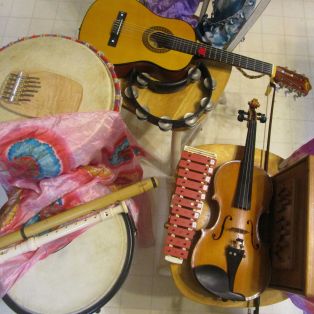
Expressive arts can help us process our stories and be the vehicle of sharing stories that are hard to speak in words. In my expressive art gatherings, we create music, movements, arts, and dance together, and share stories with each other. As we discover who we are, we get better at expressing ourselves authentically. As we co-create together, we learn how to connect with each other in life. The gallery page features participant arts and my own, and also some recordings.
After all, life is like improvisation. We co-create our conversation and all kinds of interactions by observing and responding to cues within and without based on what we know about the world. If we want to change the way we respond or react, we need to change the way we know about the world of which we are a part.
This video is about using expressive arts to process anger.
This video is about creating a memorial using found objects in nature.
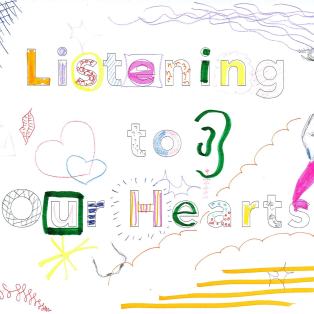
Listening to Our Hearts is a five-part online journey to help you reflect on your life and let go of things in order to become more true to yourself. Each part of this free workshop consists of a 15-minute video of guided improvisational arts with my original contemplative music in the background.
Please contact me.
 Accompanist for the Soul